Coaching standard
How we build a program
Every program at Bodyinmotionlife starts with the same 90-minute assessment and is written as a 12-week block. The format you train in — 1-to-1, small group, remote — is how the block is delivered. The method underneath does not change with the price of the hour.
01
Assessment
We measure joint range at the ankle, hip, thoracic spine and shoulder, then look at single-leg control in a simple stance and a step-down. Breathing pattern is noted at rest and under a light brace, because a lift that looks fine on the first rep often changes when someone holds their breath without meaning to. None of this is a medical exam. It is a training screen so the first loaded week is not a guess.
Load history matters as much as the screen. We ask what you have actually lifted, run, or rowed in the last year, what stopped, and what a practitioner has already limited. The weekly schedule is written in hours, not in hopes: commute, care responsibilities, shift work, and the nights you already know are short. A typical 12-week block is sized to that calendar, which is why the assessment is ninety minutes instead of a rushed consult.
90 minScreen, history, calendar
5Markers we always take
2 daysWritten summary follows
Block design
A block is twelve weeks in three phases of four. The first phase is orientation: technique at moderate loads, usually in a range of about 60–70% of a recent best where we have one, or an RPE of 6–7 where we do not. The second phase raises density and load, often 70–80% or RPE 7–8, with a written deload in week four and week eight. The third phase is a modest peak or a holding pattern, depending on whether you have an event, a travel month, or a return-to-work date.
Percentages and RPE live side by side on the sheet because a percentage without a recent best is theatre, and an RPE without a number is hard to repeat. Conditioning is written in the same phases: easy aerobic work early, then intervals with a cap, then a taper if a race is on the calendar. Accessory work exists to keep the main lifts honest — hamstrings, upper back, calves — not to add a second program in the margins.
If the assessment found a constraint from a practitioner, that constraint is printed at the top of every week. The phase still exists; the ceiling is lower until the letter says otherwise. Members commonly report that the first four weeks feel almost too quiet. That is the calibration.
Delivery
The week lives in two places: the app, and a paper sheet on the clipboard at your platform. The paper is what the coach marks during the session — loads, missed reps, a note if a lift was swapped. The app is what you see on Sunday night and what a remote week runs on. We keep both because a phone on a wet platform is a bad log, and a paper sheet does not travel to a hotel gym.
Attendance is ticked. Loads are recorded. If you skip a session, the next one is not automatically “harder to make up.” The coach decides whether to repeat, reduce, or skip ahead, and that decision is dated on the sheet. Two check-ins a month catch the weeks where sleep or soreness is doing more work than the program. Class-only members get that conversation on the floor; 1-to-1 and remote members have it on the calendar.
Coaching standards
Every program is built by a certified coach. The floor standard we hire to is CSEP-CPT or NSCA-CSCS/CPT, or an equivalent that we have already mapped to those scopes. New coaches work under supervision on the floor before they take a 1-to-1 book of their own. Continuing education is a yearly hour requirement, logged, with a bias toward practical courses — loading, gait, and working beside a practitioner — rather than a pile of unread certificates.
The coaching team shares a single program file per member. If you see a different face on a Thursday than on a Monday, they are reading the same sheet. We do not invent a second program because the usual coach is on a course. Minimum supervision on a class is one coach to eight in strength, one to ten in conditioning, one to twelve on the mats. Those caps are in the timetable, not only in a policy binder.
Working with practitioners
When someone arrives after physiotherapy, surgery, or a physician’s restriction, we ask for written clearance before we load the program. The letter is the constraint list. We do not interpret a scan, and we do not reverse a practitioner’s limit because a lift “looked fine.” If the practitioner wants a progress note, we send a short factual one: sessions attended, loads in the allowed patterns, and anything the member asked us to flag.
We are happy to get on a call with a clinic in Ottawa when the member has said we may. Coordination is part of the post-rehab block at $1,140; it is also available inside regular 1-to-1 when a new clearance arrives mid-program. If there is no letter, we will still train general fitness that stays away from the sore structure — and we will say clearly that we are waiting on the practitioner for anything more specific.
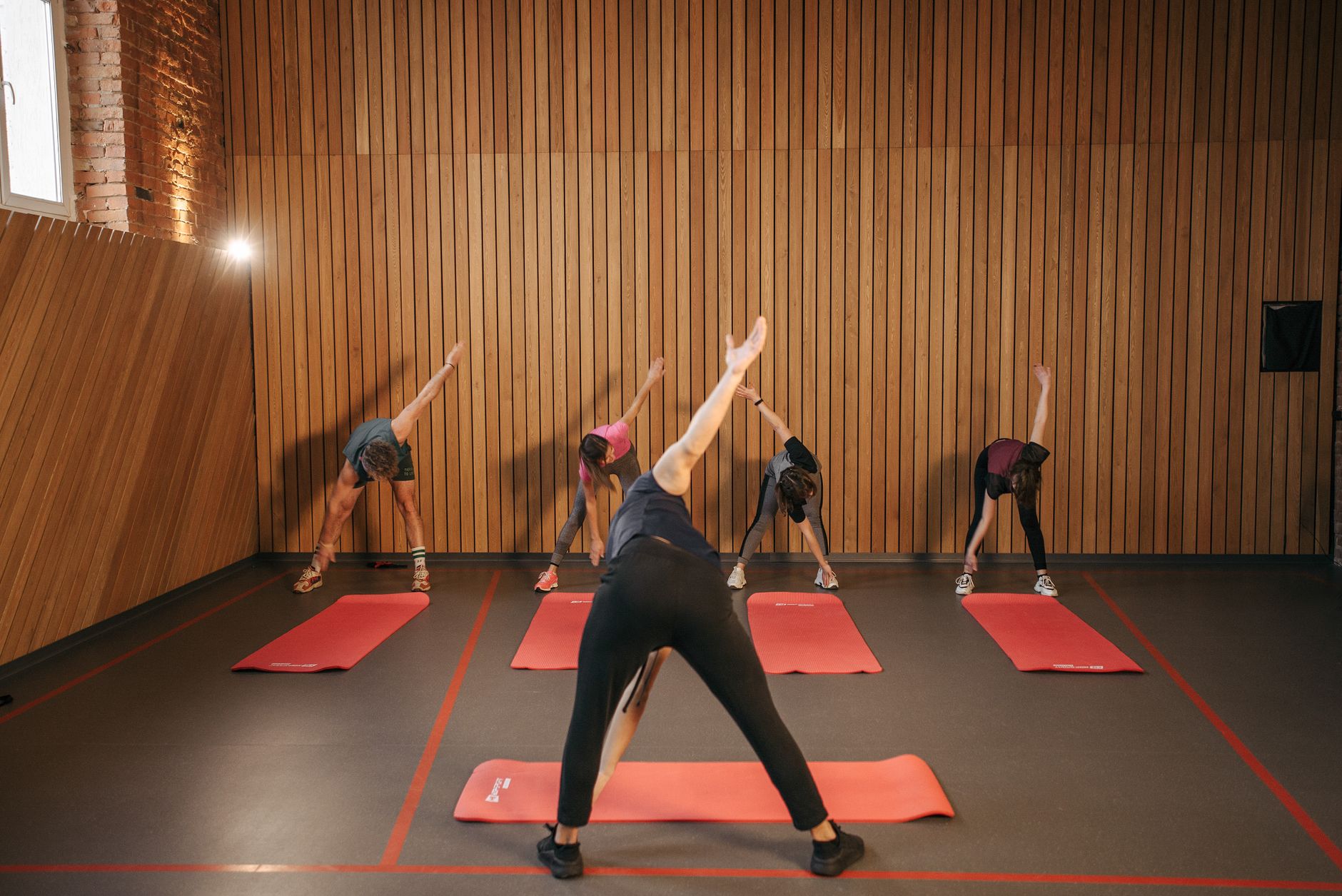
Cool-down on the mats
Retest and what counts as progress
At week 12 we repeat the movement screen, note the working loads in the key patterns, look at attendance, and ask a short self-report on sleep and pain. Those four markers are what we write down. A typical 12-week block shows some combination of a quieter screen, a higher working set at the same RPE, and a week that was actually kept. Members commonly report that clothes or a commute feel easier; we treat that as useful colour, not as a substitute for the retest.
Timelines are individual. A person returning from a calf strain and a person preparing for a fall marathon can share a coach and still need different clocks. We do not set a date on the wall for a particular body-weight or a particular 5K. If the retest is flat, the next block is rewritten — often with less density, not more slogans. If the retest is strong, you choose whether to stay in the same format or change how the next twelve weeks are delivered.